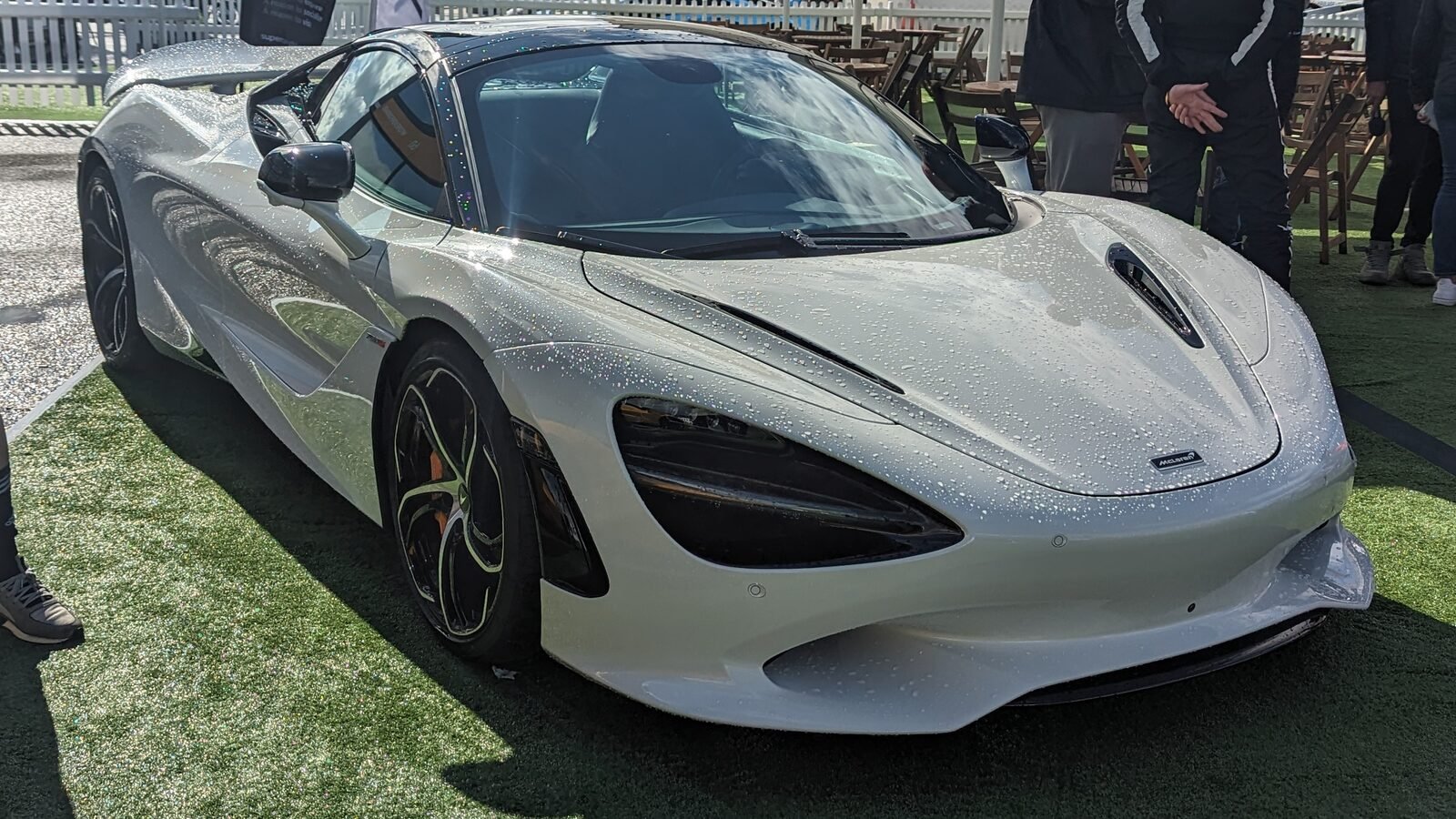
McLaren 788HS: 0-60, Specs and Price
McLaren claims the 788HS reaches 62 mph in 2.8 seconds and 124 mph in 7.0 seconds, on its way to a 205 mph top speed. It makes 788 PS (777 bhp) from the 4.0-liter twin-turbocharged M840T V8, weighs 1,265 kg dry and is limited to 200 cars: 100 coupes and 100 Spiders, every one specified through McLaren Special Operations (MSO).
The car was revealed at the Goodwood Festival of Speed on July 9, 2026. McLaren calls it the "definitive and final evolution" of the rear-drive, non-hybrid V8 family that began with the 720S in 2017 and continued through the 765LT and 750S. You can see how those cars stack up against everything else in our 0-60 times by car table. Every number on this page is a manufacturer claim; no outlet has published an instrumented test yet because deliveries have not started.
McLaren 788HS Specifications
Figures below are McLaren's, as reported by Motor1, evo, CarExpert, Goodwood and paultan.org from the reveal material.
| Spec | McLaren 788HS |
|---|---|
| Engine | 4.0L twin-turbo V8 (M840T) |
| Power | 788 PS / 777 bhp / 580 kW at 7,500 rpm |
| Torque | 800 Nm / 590 lb-ft |
| Redline | 8,500 rpm |
| Gearbox | 7-speed dual-clutch |
| Drive | Rear-wheel drive, no hybrid assistance |
| 0-62 mph (0-100 km/h) | 2.8 s (claimed) |
| 0-124 mph (0-200 km/h) | 7.0 s (claimed) |
| Top speed | 205 mph (330 km/h) |
| Dry weight | 1,265 kg / 2,789 lb (coupe) |
| Power-to-weight | 614 bhp per tonne (623 PS per tonne) |
| Downforce | 10% more than the 765LT |
| Wheels and tires | 19-inch front, 20-inch rear forged center-lock wheels on Pirelli P Zero Trofeo R |
| Brakes | Carbon-ceramic, derived from the Senna |
| Production | 200 (100 coupe, 100 Spider) |
| Price | From about GBP 450,000 in the UK (Autocar); AUD 1,078,800 in Australia (CarExpert); US price not announced |
The Spider is 49 kg heavier than the coupe, per evo, which puts it at roughly 1,314 kg dry. That is the usual cost of a folding hard top and the extra structure it needs.
What Does HS Mean on a McLaren?
HS stands for High Sport, according to Goodwood and CarExpert. The 788HS is the third McLaren to carry it:
1. MP4-12C HS (2012): five cars built for customers who wanted a sharper 12C. 2. MSO HS (2016): 25 cars based on the 675LT with 688 PS, widely nicknamed the "688HS". 3. 788HS (2026): the first HS car to put its output in the name and the first built in triple figures.
As with McLaren's other numbered cars, the 788 is the output in metric horsepower (PS).
Why Is the 0-62 Time the Same as the 750S?
The 788HS has 38 PS more than the 750S and 12 kg less dry weight, yet McLaren quotes the same 2.8-second 0-62 mph time. Hybrid rivals such as the Lamborghini Temerario use front electric motors to put power down from rest; the 788HS has only its rear tires. Two things explain the flat 0-62 figure.
Traction sets the launch, not power. Below about 40 mph, a rear-drive car with roughly 750 bhp is limited by how much torque the rear tires can put down. Extra power cannot be used until the tires stop slipping, so 0-62 barely moves between the two cars.
The extra downforce costs drag. McLaren says the 788HS makes 10% more downforce than the 765LT and that the added drag is why it is not quicker than the 765LT in a straight line. Drag barely matters at 30 mph but grows with the square of speed, so the penalty shows up near the top of the speed range.
The more telling number is 0-124 mph in 7.0 seconds, 0.2 seconds quicker than the 750S's 7.2. Above about 60 mph the car is no longer traction-limited, and the extra power finally shows. If you want to see how weight and output translate into acceleration, the power-to-weight calculator shows where 614 bhp per tonne sits against other supercars.
How Did the 720S, 765LT and 750S Compare?
McLaren's own claims for the family look like this:
| Model | Year | Power | 0-62 mph (claimed) | 0-124 mph (claimed) |
|---|---|---|---|---|
| 720S | 2017 | 720 PS / 710 bhp | 2.9 s | 7.8 s |
| 765LT | 2020 | 765 PS / 755 bhp | 2.8 s | 7.2 s |
| 750S | 2023 | 750 PS / 740 bhp | 2.8 s | 7.2 s |
| 788HS | 2026 | 788 PS / 777 bhp | 2.8 s | 7.0 s |
McLaren's US figures for the 765LT and 750S are quoted as 2.7 seconds to 60 mph, because 60 mph comes slightly before 62 mph. That is a unit difference, not a different car.
What Will a 788HS Run in the Real World?
Probably quicker than the claim. McLaren's 2.8-second figure is conservative for this family. Car and Driver's 750S test, as reported by 0-60specs, recorded 2.3 seconds to 60 mph and a 9.8-second quarter mile at 145 mph. DragTimes recorded a 765LT running the quarter mile in 9.33 seconds at 150.87 mph, per Motor1.
Those magazine numbers use a 1-foot rollout, the drag-strip convention that starts the clock after the car has already moved a foot. That trims a few tenths off a true standing start. When you time a 788HS (or any car) with FastTrack's GPS timer, you can view the run with or without rollout, so you can compare like with like. Our guide to how GPS 0-60 timing works covers why the two numbers differ.
For a 788HS on a warm, prepped surface, expect the 0-60 to land well under 2.8 seconds with rollout, and the trap speed to tell you more about the car than the launch does. You can estimate a quarter-mile trap from power and weight with the trap speed calculator.
What Changed Besides the Engine?
Beyond the power increase, the 788HS gets:
- Center-lock forged wheels, a first for this family.
- Senna-derived carbon-ceramic brakes.
- A ride height 5 mm lower at the front than the 750S.
- An open differential with Brake Steer, McLaren's system that brakes the inside rear wheel to sharpen turn-in.
- Exposed carbon-fiber bodywork offered for the first time, plus a full-length contrast stripe option.
- A numbered build plaque listing the four cars in the lineage: 720S, 765LT, 750S and 788HS.
Is the 788HS the Last Non-Hybrid McLaren V8?
It is the final evolution of the 720S-based V8 family, which is the claim McLaren makes. Whether it is the last non-hybrid McLaren V8 of all is less certain. evo put that as a question in its headline, and the 750S itself stays in production until 2027 per Carscoops.
What is clear is where McLaren's flagship has gone. The McLaren W1 pairs a 928 PS twin-turbo V8 with a 347 PS electric E-module for 1,275 PS (1,258 bhp) combined, still driving only the rear wheels. For where the 788HS sits among this year's quickest cars, see the fastest cars of 2026 ranked by 0-60.
FAQ
What is the McLaren 788HS 0-60 time?
McLaren claims 0-62 mph (0-100 km/h) in 2.8 seconds, which works out to roughly 2.7 seconds to 60 mph. That matches the 750S. No independent test exists yet, but Car and Driver's 750S test recorded 2.3 seconds to 60 mph with a 1-foot rollout, so a real 788HS is likely to beat its claim on a good surface.
How much horsepower does the McLaren 788HS have?
The 4.0-liter twin-turbo V8 makes 788 PS, which is 777 bhp or 580 kW, at 7,500 rpm, plus 800 Nm (590 lb-ft) of torque. The engine revs to 8,500 rpm.
How many McLaren 788HS will be built?
200 in total: 100 coupes and 100 Spiders. Every car is individually specified through McLaren Special Operations and built in Woking.
How much does the McLaren 788HS cost?
Autocar reports a UK starting price of about GBP 450,000, and CarExpert lists AUD 1,078,800 in Australia before on-road costs. McLaren has not announced a US price.
What does HS stand for on the McLaren 788HS?
High Sport. The 788HS is the third McLaren HS model, after five MP4-12C HS cars in 2012 and 25 MSO HS cars (the "688HS") based on the 675LT in 2016.
How does the 788HS compare to the 750S?
The 788HS has 788 PS against the 750S's 750 PS, weighs 12 kg less dry, makes 10% more downforce than the 765LT, and reaches 124 mph 0.2 seconds sooner (7.0 vs 7.2 seconds). Both claim 2.8 seconds to 62 mph.
How fast is the McLaren 788HS?
McLaren quotes a top speed of 205 mph (330 km/h).