How FastTrack Gets Pro-Grade Timing Accuracy From Your Phone
Last reviewed: · FastTrack Engineering
Bottom line. FastTrack measures 0-60 mph times within ±0.02 seconds on an iPhone or Android phone with clear sky view, inside the accuracy window of a standard Dragy and within hundredths of flagship hardware like the Dragy Pro and RaceBox. It pairs your phone's GPS with the internal accelerometer using sensor-fusion math from the same family proven on Apollo 11. The remaining gap to dedicated devices is GPS antenna hardware, not software.
FastTrack's 0-60 times land within ±0.02 seconds, close enough to dedicated $200+ hardware that the difference comes down to GPS antenna quality, not software. The engine fuses Doppler GPS with your phone's 100 Hz accelerometer using the same class of sensor-fusion math NASA trusted to fly Apollo 11 to the Moon.
Headline Figures
- ±0.02s 0-60 accuracy, within the standard Dragy's ±0.03s window and within hundredths of Dragy Pro and RaceBox under normal conditions
- ~30ms launch detect latency, the 100Hz accelerometer registers acceleration onset roughly 3× faster than GPS-only launch detection (~100ms)
- 100Hz accelerometer sample rate, paired with GPS through a sensor-fusion approach that blends both signals continuously
- 3–5× tighter than GPS-only, the gap that remains is hardware: dedicated devices have purpose-tuned external antennas; a phone sits inside the cabin
What Sensor Fusion Actually Does
GPS knows your absolute speed but only updates once per second and carries noise. The accelerometer updates 100 times per second and is very responsive, but drifts over time. The fusion algorithm blends them continuously so the result is both fast and stable, the same approach used in Apollo guidance computers, SpaceX landing systems, Tesla Autopilot, and self-driving research vehicles.
How These Numbers Were Measured
The accuracy figures on this page are based on side-by-side comparison testing against reference timing hardware.
- Reference devices: Dragy (standard), Dragy Pro, and RaceBox Mini.
- Method: FastTrack and the reference device record the same run on the same vehicle simultaneously. The reported “FastTrack accuracy” for each metric is the typical observed delta between FastTrack and the reference, not a best-case single-run delta.
- Conditions: Flat, unobstructed roads with clear sky view. iPhone mounted on the windshield via a standard suction mount. Good GPS lock required for a run to count toward the comparison.
- What we did not test: Performance in tunnels, urban canyons, dense forest, or heavy precipitation. Dedicated devices retain a meaningful edge in these environments because of their roof-mounted, purpose-tuned antennas.
These figures describe FastTrack's current production engine and are revised when the underlying algorithm changes. See “Last reviewed” above for the date of the most recent validation pass.
How Close to Dragy and RaceBox?
For 0-60 times, FastTrack is now within a few hundredths of Dragy and RaceBox under normal conditions. The math and algorithm class are effectively the same. The remaining gap is almost entirely hardware: a dedicated device has a purpose-tuned external antenna with clear sky view, while a phone sits inside the cabin. For most enthusiasts, FastTrack is the accuracy they need without spending $150 to $500 on extra hardware.
FastTrack vs Dragy | FastTrack vs RaceBox | Timing Accuracy Deep Dive
Same run, 0.01 seconds apart
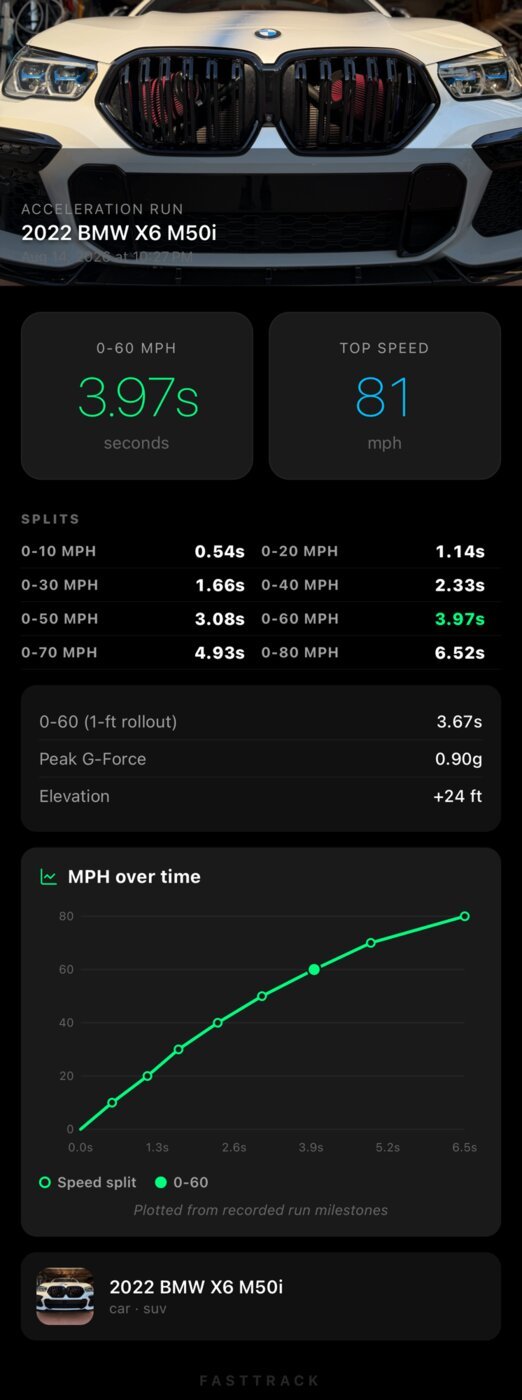
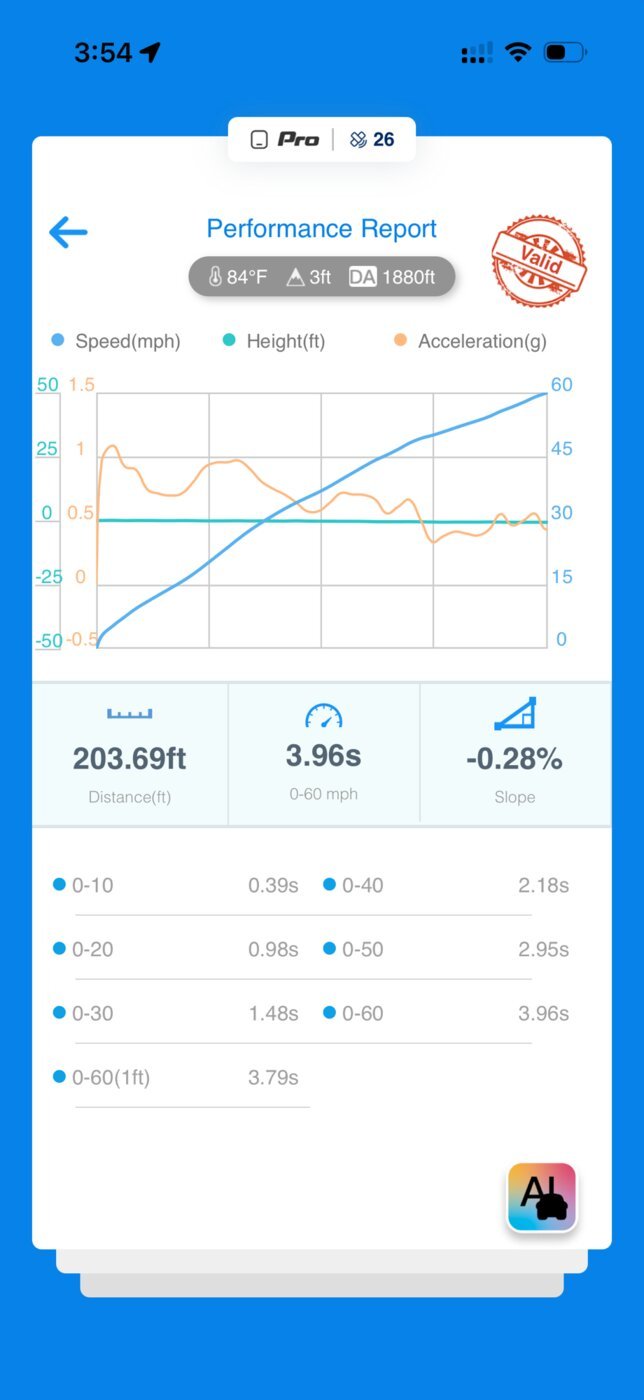
A FastTrack run on a phone next to a Dragy GPS meter, the same 2022 BMW X6 M50i, recorded at the same time. FastTrack read 3.97s to 60 mph; the dedicated Dragy read 3.96s, and the two also landed within 0.01s at the quarter mile.
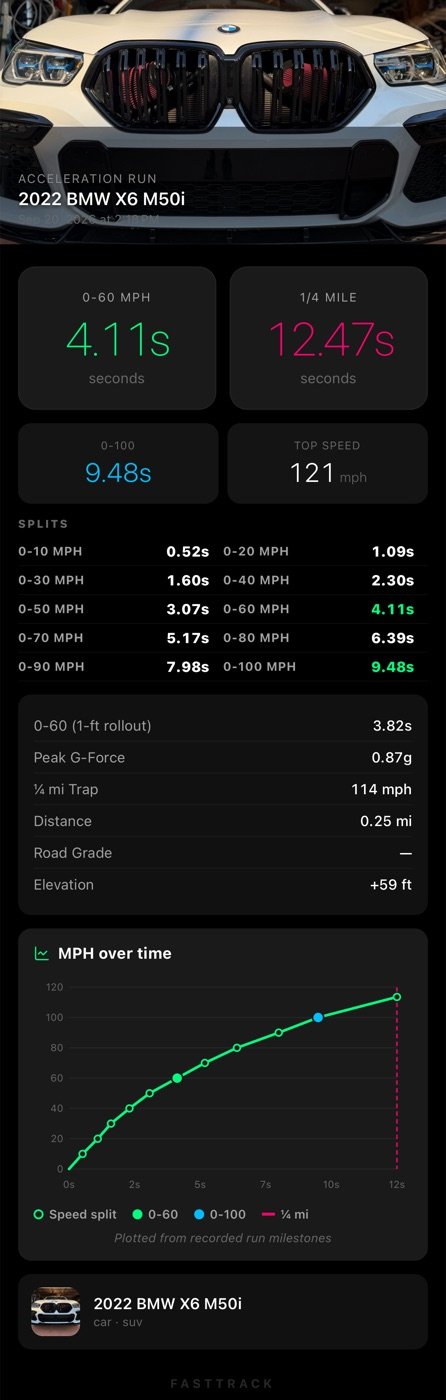
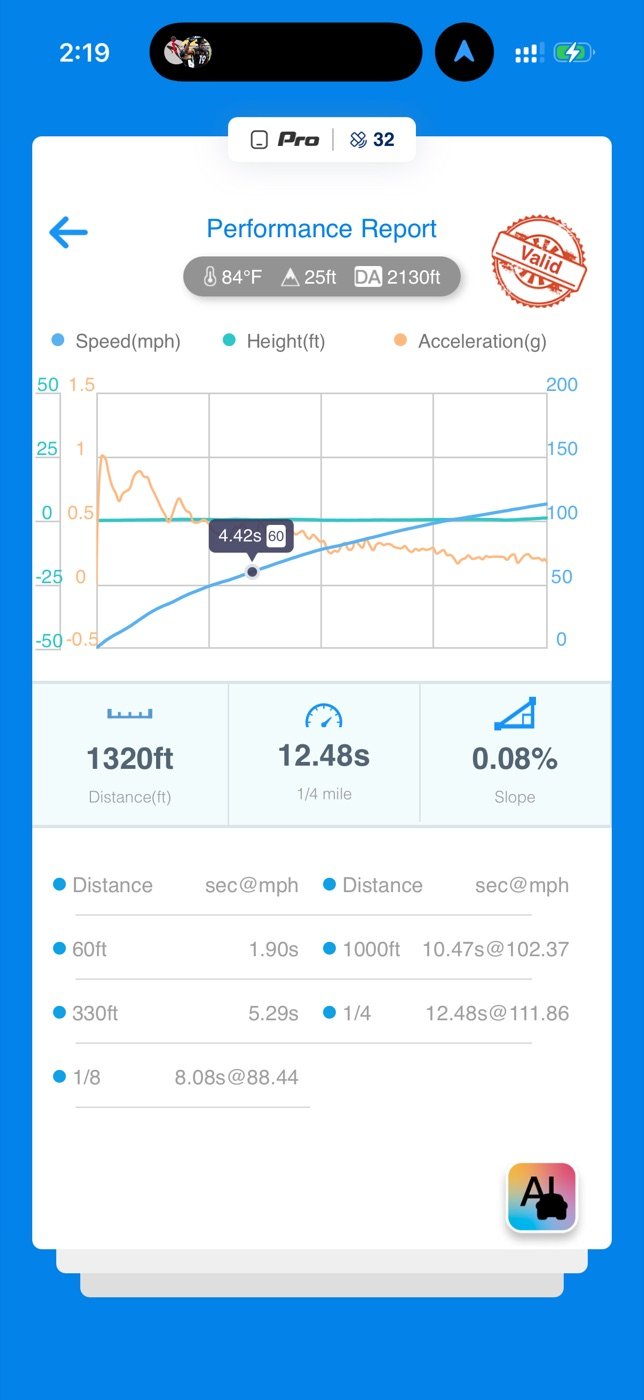
On a full pull, FastTrack ran the quarter mile in 12.47s at a 114 mph trap; the Dragy read 12.48s and 111.86 mph on the same run.
| Metric | FastTrack (phone) | Dragy (GPS meter) | Difference |
|---|---|---|---|
| 0-60 mph | 3.97 s | 3.96 s | 0.01 s |
| 1/4 mile ET | 12.47 s | 12.48 s | 0.01 s |
| 1/4 mile trap speed | 114 mph | 112 mph | 2 mph |
What Each Number Means
- 0-60 mph accuracy
- Typical difference between FastTrack's reported 0-60 mph time and the reference device's reported time on the same run. Not absolute speed-measurement error.
- Quarter-mile ET accuracy
- Typical difference between FastTrack's elapsed time across a measured 1320 ft and the reference device's elapsed time across the same run.
- Trap speed accuracy
- Typical difference between FastTrack's reported speed at the end of the quarter mile and the reference device's reported trap speed on the same run.
- Launch detection latency
- Time between true wheel motion onset and the moment the timer starts running. Measured against a high-speed video reference frame-by-frame in algorithm testing.
- Run-to-run consistency
- Standard deviation of FastTrack's reported 0-60 time across back-to-back identical runs (same car, same road, same driver, same weather). Quantifies repeatability, not accuracy.
Error Sources We Account For (And Some We Cannot)
FastTrack handles these in software:
- GPS multipath, signal bouncing off nearby surfaces. FastTrack detects and rejects spurious fixes before they reach the timer.
- Accelerometer drift, the motion chip drifts over seconds. FastTrack continuously corrects for it against GPS so the result stays anchored.
- Mount vibration, small movements in a windshield mount are filtered out before they reach the reported speed.
What software cannot fix:
- Cabin attenuation, a phone's GPS antenna sits inside the car and loses signal strength compared to a roof-mounted dedicated device. Software cannot make the antenna physically larger.
- Severe multipath in urban canyons, high-rise reflections can defeat even sophisticated antennas; dedicated devices have the advantage here.
- Tunnels and heavy tree cover, extended GPS dropouts. After several seconds without a fix, every consumer device, FastTrack included, loses accuracy.
We ship the real numbers. No “within a tenth” marketing on a graph that shows anything. The tables on this page are what we measure against reference hardware in testing.
References
- NASA, Software Design of the Apollo Guidance Computer (NTRS-19720005184). Background on the sensor-fusion math first proven on Apollo 11 that now underpins navigation across modern aerospace and automotive systems.
- Apple Developer, Core Motion & Core Location. Apple's public documentation for the iPhone sensor APIs that any iOS timing app builds on top of.
Download FastTrack Free on the App Store or Google Play
Frequently Asked Questions
How accurate is FastTrack for 0-60 times?
FastTrack now achieves ±0.02 seconds for 0-60 mph on an iPhone or Android phone with clear sky view. That puts it inside the accuracy range of the standard Dragy (±0.03s) and within a few hundredths of flagship hardware like the Dragy Pro and RaceBox. The improvement comes from fusing the phone's 100Hz accelerometer with GPS using the same mathematical family used in aerospace navigation.
Is FastTrack as accurate as a Dragy or RaceBox now?
For 0-60 times, FastTrack is now within a few hundredths of Dragy and RaceBox under normal conditions. The remaining gap is almost entirely hardware: dedicated devices have purpose-tuned antennas with clear sky view, while a phone sits inside the cabin. The math and algorithm approach are effectively the same.
What is sensor fusion?
Sensor fusion is the technique of combining multiple imperfect measurements of the same thing into one much better estimate. GPS knows your absolute speed but only updates once per second and has noise. The accelerometer updates 100 times per second and is very responsive, but drifts over time. The algorithm blends them continuously so the result is both fast and stable, this is the same approach used in Apollo guidance computers, SpaceX landings, and self-driving cars.
What hardware did FastTrack test against?
FastTrack's accuracy figures are based on side-by-side comparison testing against the standard Dragy, the Dragy Pro, and the RaceBox Mini. The reference device and FastTrack record the same run on the same vehicle, and the reported accuracy is the typical observed difference between the two, not a best-case single-run delta.
What conditions affect FastTrack's accuracy?
Clear sky view and a stable mount are the two largest factors. Heavy tree cover, urban canyons, tunnels, and severe weather reduce GPS quality and widen FastTrack's error bands more than they do for a dedicated device with a roof-mounted antenna. The fusion algorithm corrects for accelerometer drift and brief GPS multipath, but it cannot make the phone's antenna physically larger.
How often is FastTrack's accuracy data revalidated?
FastTrack revalidates its accuracy figures against reference hardware whenever the production timing engine changes. The "Last reviewed" date at the top of this page reflects the most recent validation pass.