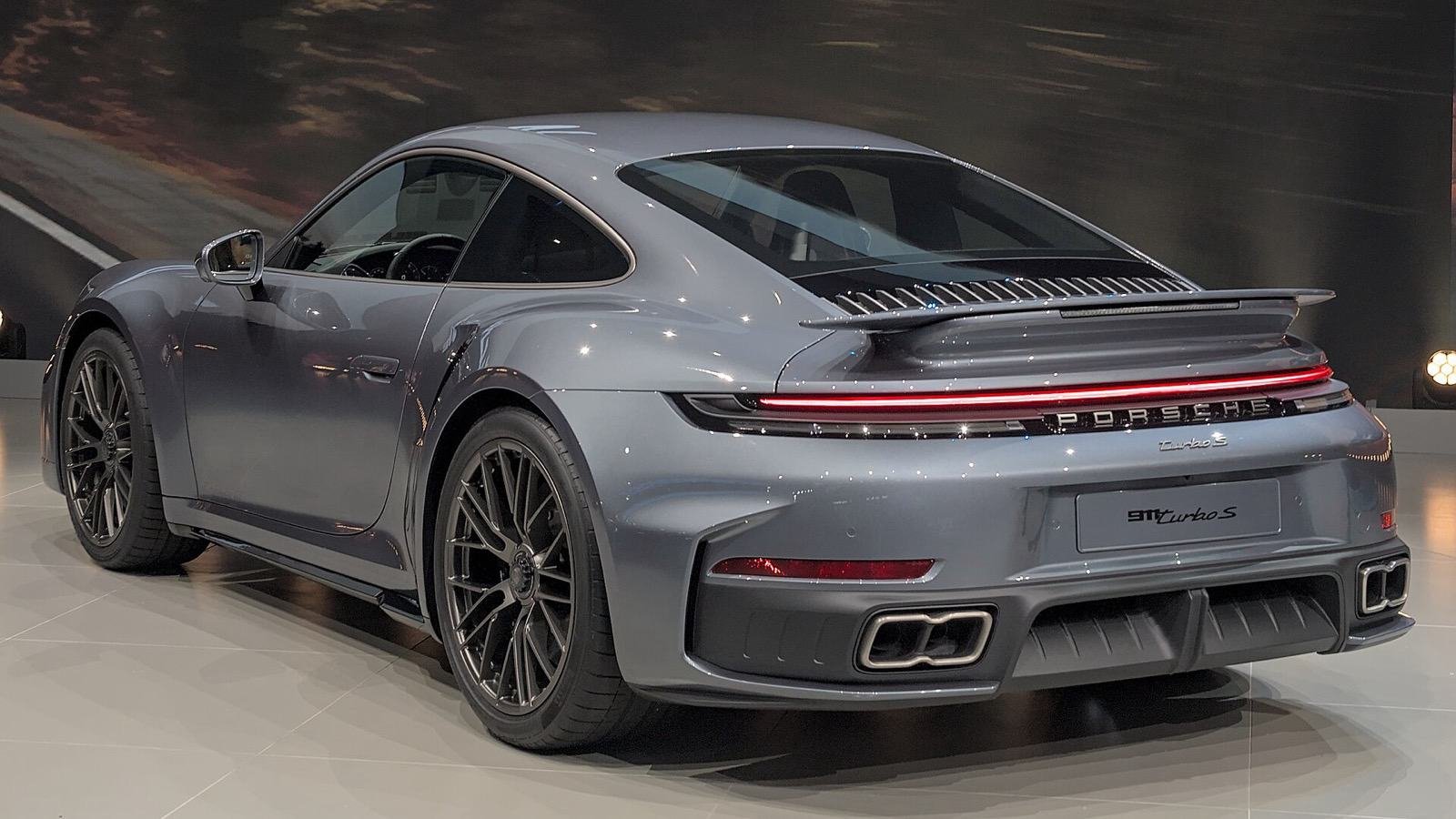
Porsche 911 Turbo S Hybrid: 0-60 & Quarter Mile
Porsche's factory claim for the 2026 911 Turbo S is 2.4 seconds to 60 mph. Car and Driver tested the production car and recorded 2.0 seconds, four tenths quicker than the badge on the door. The quarter mile came out at 9.7 seconds at 142 mph, the quickest number any stock 911 has returned in independent testing. That gap between the manufacturer figure and the tested result is not an error. It is the story of how this car was built, how manufacturer claims are written, and what you will actually see when you measure a run yourself.
The Gap: Why Porsche Claims 2.4s and C&D Measured 2.0s
Porsche's 2.4-second figure is a conservative, legally defensible specification measured under controlled conditions. The company publishes it without specifying whether it uses a one-foot rollout (the convention where the timer starts after the car has moved the first foot from a standstill), and Porsche does not tune their claims for maximum marketing impact the way some rivals do. If anything, Porsche's historical tendency is to understate.
Car and Driver's test, conducted in March 2026, used a one-foot rollout, the standard US automotive testing convention that most American magazines and the NHRA drag-racing timing system use. Because the first foot of a launch is the slowest part of any run (the car is barely moving and grip is being established), rolling the clock after that first foot removes the hardest tenths from the final number.
The result: 2.0 seconds with rollout. If you test your own 911 Turbo S on a GPS timer from a true standstill, add roughly 0.2 to 0.4 seconds, so expect 2.2 to 2.4 seconds under normal street conditions. That is still sub-2.5 from a $270,000 flat-six. And it is genuinely quicker than a Porsche 918 Spyder, which Car and Driver tested at around 2.5 seconds back in its day.
| Measurement | Source | Result |
|---|---|---|
| 0-60 mph (factory claim) | Porsche USA | 2.4 s |
| 0-60 mph (tested, 1-ft rollout) | Car and Driver, March 2026 | 2.0 s |
| 0-60 mph (GPS, true standstill, est.) | Street conditions | ~2.2–2.4 s |
| 0-100 mph (tested) | Car and Driver | 4.8 s |
| Quarter mile (tested) | Car and Driver | 9.7 s @ 142 mph |
| Top speed | Porsche | 200 mph |
| Starting price (coupe) | Porsche USA | $270,300 |
The T-Hybrid System: What 701 HP Actually Means
The 2026 911 Turbo S introduces what Porsche calls the T-Hybrid system, a package that sounds mild until you look at the engineering. The base is the familiar 3.6-liter twin-turbocharged flat-six, now producing 621 hp on its own. An 80 hp electric motor sits integrated directly into the 8-speed PDK transmission. Together, the system makes 701 hp and 590 lb-ft of torque.
The key innovation is not the electric motor alone, it is the electric turbochargers. Rather than conventional turbochargers that spin up on exhaust gas alone, the twin turbos on the T-Hybrid include an electric assist that can spin the compressor at up to 145,000 rpm almost instantly. Turbo lag, the brief but noticeable hesitation between throttle input and boost, has been engineered out of the equation. When you press the accelerator, the torque is essentially immediate.
| Component | Specification |
|---|---|
| Engine | 3.6-liter twin-turbo flat-six |
| Engine output | 621 hp |
| Electric motor location | Integrated into PDK transmission |
| Electric motor output | ~80 hp |
| System total | 701 hp / 590 lb-ft |
| Battery buffer | 1.9 kWh |
| eTurbo boost pressure | 26.1 psi (electric-assisted, up to 145,000 rpm) |
| Transmission | 8-speed PDK |
| Drive | AWD |
The 1.9 kWh battery is not designed for EV-only driving, you cannot run this car silently for two miles the way you can in a plug-in hybrid. The battery exists purely as a performance buffer, absorbing regenerative energy and then discharging it during hard acceleration. There is no charging port. This is a performance tool, not a compliance EV.
Nürburgring: 7:03.92, 14 Seconds Quicker Than Before
The 2026 Turbo S completed the Nürburgring Nordschleife in 7:03.92, driven by Jörg Bergmeister and notarially confirmed. The previous generation 911 Turbo S (the 992.1, without the hybrid system) set a 7:17.98, which means the T-Hybrid took 14 seconds off the Nürburgring time of a car that already ranked among the quickest production machines on the circuit. A 14-second improvement at the Ring is significant. The same stretch of road that previously took 7 minutes and 18 seconds now takes 7 minutes and 4 seconds.
How Does It Compare? Placing the 2.0s in Context
The relevant comparisons are all cars at or near the Turbo S's price and performance tier.
| Car | 0-60 (tested or best claim) | Quarter mile | Price |
|---|---|---|---|
| 2026 Porsche 911 Turbo S | 2.0 s (C&D, 1-ft rollout) | 9.7 s @ 142 mph | $270,300 |
| Ferrari SF90 Stradale | ~2.0 s (tied in C&D context) | ~9.0 s | ~$400K+ |
| 2026 Corvette ZR1X | 1.68 s prepped / 1.89 s unprepped (GM) | 8.675 s prepped | ~$207,100 |
| Porsche 918 Spyder (context) | ~2.5 s (historical C&D) | 9.7 s | $910K+ used |
| Previous 911 Turbo S (992.1) | 2.7 s (prior C&D test) | 10.8 s @ 137 mph | $180,700 |
A few things the table makes clear:
The 2026 Turbo S is a significant upgrade over its predecessor, seven tenths quicker to 60 mph, 1.1 seconds quicker in the quarter mile, 14 seconds quicker around the Nürburgring.
Against the Corvette ZR1X, the 911 Turbo S wins to 60 mph (2.0 vs. 1.89 seconds unprepped, or 2.0 vs. 1.68 on a prepped surface). Above 60 mph, the Corvette's 1,250-hp advantage takes over rapidly, it reaches 100 mph significantly quicker and pulls away hard from there. The Porsche wins the initial sprint; the Corvette wins the drag race from there.
Against the Ferrari SF90 Stradale, Car and Driver's test puts them essentially tied to 60 mph. The SF90 pulls away above that speed with its 986 hp hybrid system.
The comparison to the 918 Spyder is just a data point, not a real-world matchup, but it is striking that a $270,000 production sports car now replicates what a $910,000 hypercar did a decade ago.
What Your GPS Timer Will Actually Show
The C&D figure of 2.0 seconds is real, but it has context. The test was conducted on a prepped surface with launch control active and a one-foot rollout. On an unprepped public road with a GPS timer measuring from a true standstill, the real range is 2.2 to 2.4 seconds, consistent with the Porsche factory claim and with what enthusiasts typically report.
That is not a knock on the car. A consistent 2.2-second 0-60 from a true standstill, on street tires, on public pavement, is extraordinary. The point is that the 2.0-second figure and the 2.4-second figure are both honest, they are measuring different things under different conditions.
FastTrack's GPS timing captures the full speed-over-time curve so you can compare your own run to both the manufacturer claim and the magazine test on equal terms. The performance leaderboards will accumulate real 911 Turbo S times from owners as the car reaches the road, the leaderboard is where you see how a real car performs for real people, not just in controlled press events.
For more on how manufacturer claims, magazine tests, and GPS-measured times differ, and what it means when all three numbers are different, see our guide to measuring your 0-60 time. For the context of how the 911 Turbo S fits into the broader fastest cars of 2026, it belongs at the very sharp end for a production sports car.
FAQ
What is the 2026 Porsche 911 Turbo S 0-60 time?
Porsche's factory claim is 2.4 seconds. Car and Driver tested the car in March 2026 and recorded 2.0 seconds with a one-foot rollout. On a GPS timer from a true standstill on an unprepped road, expect 2.2 to 2.4 seconds depending on surface and conditions.
What is the 2026 Porsche 911 Turbo S quarter-mile time?
Car and Driver's test returned 9.7 seconds at 142 mph, the quickest result any production 911 has posted in independent testing.
How much does the 2026 Porsche 911 Turbo S cost?
The coupe starts at $270,300 in the US including destination. The cabriolet starts at $284,300.
Is the 2026 Porsche 911 Turbo S faster than the Corvette ZR1X?
To 60 mph, yes, the Turbo S clocks a tested 2.0 seconds versus the ZR1X's best-case 1.68 seconds on a prepped surface (or 1.89 seconds unprepped). Above 60 mph, the ZR1X's 1,250 hp pulls away rapidly. The Porsche wins the sprint; the Corvette wins the longer drag race.
What is the T-Hybrid system in the 911 Turbo S?
The T-Hybrid pairs a 621 hp 3.6-liter twin-turbo flat-six with an 80 hp electric motor integrated into the PDK transmission, plus a 1.9 kWh battery buffer and electric-assisted turbochargers that spin at up to 145,000 rpm to eliminate lag. It is not a plug-in hybrid, there is no meaningful EV range, and no charging port. The system is purely a performance tool.
How does the 911 Turbo S compare to the Ferrari SF90 Stradale to 60 mph?
Both arrived at approximately 2.0 seconds in a Car and Driver comparison context, making them effectively tied to 60 mph. Beyond that, the SF90's 986 hp system pulls away. The 911 Turbo S costs roughly $270,000 versus $400,000-plus for the SF90 Stradale.