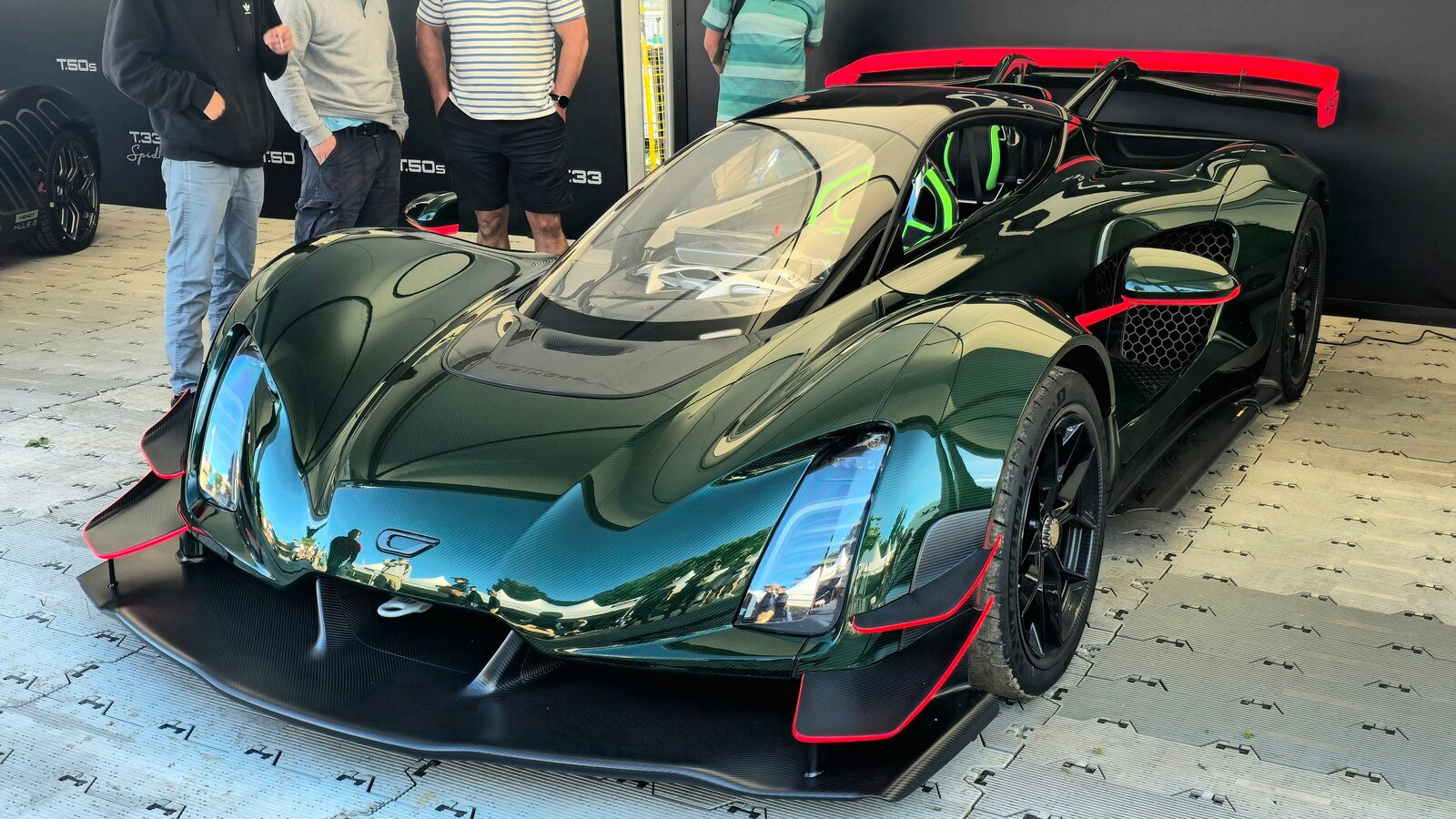
Czinger 21C Spyder: 1.9s 0-60 & Specs
The Czinger 21C Spyder claims 0–60 mph in 1.9 seconds and a quarter mile in 8.7 seconds, making it one of the fastest open-top cars by acceleration ever offered. It debuted at The Quail during Monterey Car Week on August 14, 2026, limited to 30 hand-assembled units priced from $2.75 million each.
Built at Czinger's Area 21 facility in Los Angeles, the 21C Spyder is the first convertible variant of the 21C hypercar platform, a hybrid machine developed using Czinger's AI-driven BioLogic engineering process. Here is every verified specification, what the 1.9-second figure actually means, and how the Spyder compares to the fastest open-top cars in the world.
21C Spyder: All Confirmed Specs
These figures come from Czinger's official launch materials corroborated across Carscoops, Motor1, Edmunds, TopSpeed, and Jalopnik at the Monterey 2026 reveal.
| Spec | Czinger 21C Spyder |
|---|---|
| Combined Power | 1,250 hp |
| V8 Power | 750 hp (2.88L twin-turbo, 11,000 rpm) |
| Electric Motor Power | 500 hp (three motors) |
| Combined Torque | 691 lb-ft |
| Transmission | 7-speed sequential automated manual |
| Drivetrain | AWD (rear V8, front electric) |
| 0–60 mph (claimed) | 1.9 seconds |
| Quarter mile (claimed) | 8.7 seconds |
| Top Speed (roof on) | 205 mph |
| Downforce at 150 mph (roof off) | 3,267 lb |
| Curb Weight | Not officially published |
| Production | 30 units, hand-assembled |
| Price | From $2.75 million |
| Debut | August 14, 2026, Monterey Car Week |
What Powers the 21C Spyder
The Czinger 21C Spyder runs a hybrid powertrain developed entirely in-house. The internal combustion heart is a 2.88-liter flat-plane twin-turbocharged V8 that spins to 11,000 rpm, unusually high for a forced-induction engine, and produces 750 hp and 396 lb-ft of torque. It drives the rear axle through a 7-speed sequential automated manual transmission.
Three electric motors augment the V8: two on the front axle and one connected directly to the crankshaft. They add 500 hp and 295 lb-ft for a combined system output of 1,250 hp and 691 lb-ft. All-wheel drive comes from this hybrid architecture, not from a traditional transfer case.
The V8 is Czinger's own design, not a sourced BMW or Ferrari engine, developed using the same AI-driven computational optimization that shapes the 21C's printed structural components. This is what Czinger calls BioLogic engineering: algorithmic optimization of geometry for strength-to-weight, producing shapes that look organic because they are solved, not sketched.
Understanding the 1.9s 0-60 Claim
The 1.9-second figure is Czinger's official claimed time, published in the Spyder's launch materials. It matches the original 21C coupe's claim (also 1.9 seconds). A few important caveats apply before treating that number as settled fact.
1-foot rollout convention. Like virtually all manufacturer 0-60 times, this figure almost certainly uses the drag-strip rollout standard: the clock starts after the car has moved 12 inches, not from a true standstill. That convention shaves roughly 0.1–0.3 seconds off the quoted time. A GPS measurement from true zero (what FastTrack measures on the timing app) would add approximately 0.15 seconds to the manufacturer figure, putting real-world expectation around 2.05–2.10 seconds.
No independent test yet. The 21C Spyder debuted at Monterey on August 14, 2026. As of publication, no automotive outlet (Car and Driver, Motor Trend, MotorTrend, Road & Track) has published an independent drag strip result. For a new hypercar with a manufacturer-claimed sub-2-second time, independent confirmation can take months, and sometimes doesn't arrive until customer deliveries begin.
Prepped vs. unprepped. The 1.9s claim does not specify a prepped strip. On public pavement without launch-control-optimized tire prep, expect 2.1–2.3 seconds in realistic conditions, consistent with how similar AWD hybrid hypercars (Rimac Nevera, Porsche 918, Ferrari SF90) translate from claimed to tested times.
For a deeper look at how manufacturer times translate to real-world GPS measurements, see how accurate are phone 0-60 apps and the Rimac Nevera R rollout explainer.
Why the Spyder is 0.6s Slower at the Strip Than the Coupe
The original 21C coupe claims a 1.9s 0-60 and an 8.1-second quarter mile. The Spyder matches the 0-60 but runs an 8.7-second quarter mile, 0.6 seconds slower.
The physics explanation is trap speed: quarter-mile performance at high speed is dominated by aerodynamic drag. With the roof removed, the Spyder's rear deck becomes an open cockpit, creating both increased drag and altered wake structure. Even with the 3,267 lbs of downforce the Spyder generates at 150 mph (more than any other open-top car), the aerodynamic drag forces at trap speeds of 170+ mph extract a meaningful time penalty in the second half of the quarter mile.
The Spyder almost certainly out-maneuvers the coupe in cornering at lower speeds, where that additional downforce translates directly to mechanical grip, but at the drag strip, roofless always means slower at high velocity.
Fastest Open-Top Hypercars Compared
To put the 21C Spyder's claimed 1.9s into context:
| Car | 0-60 (claimed/tested) | Quarter Mile | Status |
|---|---|---|---|
| Czinger 21C Spyder | 1.9s (claimed) | 8.7s (claimed) | Untested independently |
| Ferrari SF90 Spider | 2.5s (claimed, Ferrari) | ~10.8s | Tested by Car and Driver |
| Porsche 918 Spyder | 2.4s (tested, Motor Trend) | 9.8s | Independently verified |
| McLaren Elva | ~2.9s (estimated) | ~10.7s | No strip test published |
| Lamborghini Aventador SVJ Roadster | 2.8s (claimed) | ~10.4s | Limited independent data |
The 21C Spyder's claimed 1.9s would put it 0.6 seconds ahead of the next-fastest convertible by manufacturer claim. Until a major publication runs a drag strip test, that gap must be treated as a projection, not a measured fact.
For comparison across closed-top hypercars, the McLaren W1 (2.7s claimed) and Rimac Nevera R (1.66s claimed) give a sense of where 1.9s sits in the current generation of hypercars.
BrakeNode: A Genuine First
Alongside the performance specs, Czinger introduced two proprietary technologies at Monterey that matter for the 21C platform's real-world dynamics.
BrakeNode™ is a fully additively manufactured integrated brake assembly, designed and printed as a single structural unit rather than assembled from conventional calipers, master cylinders, and brake lines. Czinger claims it reduces stopping distance by up to 15 percent versus a conventional brake setup while saving 1.5 pounds of unsprung mass per wheel corner (six pounds total). Unsprung weight directly affects how quickly a wheel can follow road undulations, so this is a meaningful handling advantage beyond the straight-line claims.
NeuralNode is the cockpit control center, a single integrated touchscreen surface that replaces the original 21C's collection of separate buttons and displays.
Wiring the Czinger Into GPS Timing
If you're measuring your own car against these numbers, understanding the comparison requires knowing how the Czinger's claim is measured versus how your phone measures. Czinger's 1.9s is almost certainly from a 1-foot rollout; FastTrack's GPS timing starts from true standstill. The practical adjustment is adding 0.15–0.20 seconds to the manufacturer claim before comparison.
Use the quarter-mile calculator to estimate how your car's horsepower and weight project to a strip time, and then measure the real-world result with FastTrack to see how close the prediction gets. The gap between calculator-predicted and GPS-measured is where driver skill, tire prep, and ambient conditions show up in the data.
The full Monterey 2026 context, Bugatti Destrier, Porsche GT2 RS Flachbau, Ferrari CZ26, Lamborghini Revuelto SV, is in the Monterey Car Week 2026 roundup.
FAQ
How fast is the Czinger 21C Spyder 0-60?
Czinger claims 0–60 mph in 1.9 seconds, matching the original 21C coupe's claim. This is from Czinger's official launch materials at the Monterey 2026 reveal, reported consistently by Carscoops, Motor1, Edmunds, and TopSpeed. No independent outlet has yet run a drag strip test. Real-world GPS timing (no rollout) would likely show 2.1–2.3 seconds.
Why is the Spyder slower at the quarter mile than the coupe?
The Czinger 21C Spyder runs an 8.7-second quarter mile versus the coupe's 8.1 seconds, a 0.6-second deficit. At trap speeds of 170+ mph, the open-top body generates significantly more aerodynamic drag than the sealed coupe roof. The extra downforce (3,267 lb at 150 mph) helps in corners but does not offset the straight-line drag at high speed.
How many Czinger 21C Spyders are being made?
Production is limited to 30 hand-assembled units. Each is built at Czinger's Area 21 facility in Los Angeles, starting at $2.75 million. No further production run beyond the initial 30 has been announced.
Is the Czinger 21C Spyder faster than the McLaren W1?
In a straight line, the Czinger's 1.9s 0-60 claim is faster than the McLaren W1's 2.7-second claim, but they have not been independently compared on the same strip. The W1 has been through more third-party testing. The Czinger's 8.7s quarter-mile claim versus the W1's estimated 9.4–9.6s suggests the Czinger is quicker in a drag race, but the W1 figure is not officially confirmed by McLaren for that distance.
What engine does the Czinger 21C Spyder use?
A Czinger-developed 2.88-liter flat-plane twin-turbocharged V8 revving to 11,000 rpm (750 hp, 396 lb-ft) combined with three electric motors (500 hp, 295 lb-ft) for 1,250 hp and 691 lb-ft total. It is not a sourced engine from a major manufacturer, Czinger designed and builds the V8 internally.
How does the Czinger's downforce compare to other open-top cars?
At 150 mph with the roof removed, the 21C Spyder generates 3,267 lbs of downforce, which Czinger claims is the highest of any open-top road car. At speed, that figure roughly equals the car's own curb weight pressing the tires into the road, providing dramatically more mechanical grip than any conventional convertible.